Your bank knows what you spend.
But does it know when it's about to lose you?
Banks hold more information than ever. Artificial intelligence promises to turn it into decisions. But there is a question that should concern any CEO: how much growth is lost while data, departments and the customer experience remain disconnected?
October 19, 20265 min read
A customer has their salary paid into a bank.
They use the card, pay bills, make transfers and keep their savings there.
One day they start transferring money regularly to another institution.
Then they use the card less.
Later they stop using some products altogether.
And eventually, although the account is still open, the bank is no longer their first choice.
At what point did that customer start to be lost?
Almost certainly long before anyone considered them lost.
The problem is not a lack of data.
Banks record thousands of signals about their customer relationships: transactions, product usage, digital interactions, enquiries, complaints and shifts in financial behaviour.
But recording a signal is not the same as understanding it.
A recurring transfer to another institution can have many explanations.
A drop in card usage does not, on its own, prove an intention to leave.
Yet when different signals are read together, opportunities appear to understand what the customer actually needs and to act on it in a relevant way.
One figure puts the scale of what is at stake into perspective. In an analysis of 112 million customer-bank relationships across six European markets, published by McKinsey in September 2026, 48 percent of customers held only one product with their bank, and 81 percent held two or fewer.
That is European data and it cannot simply be transferred to Argentina, Mexico or the United States. But the question it raises holds in any market: how much of a relationship actually exists with the customers who already chose the bank?
The real challenge is not only to accumulate information.
It is to connect data, context, strategy and decisions.
Artificial intelligence can
accelerate the problem.
Much of today's conversation about transformation in banking revolves around artificial intelligence.
- Automation.
- Predictive models.
- Intelligent assistants.
- Personalisation.
These are tools with extraordinary potential.
But there is a prior question that does not always get enough attention:
What are we trying to improve, and how will we measure its impact on the business?
If a bank automates irrelevant communications, it will be able to send more irrelevant messages in less time.
If it applies AI to fragmented information, it can accelerate decisions built on an incomplete view of the customer.
And if it measures success only by the number of campaigns, open rates or interactions, it can lose sight of what matters: the quality of the relationship and what it contributes to growth.
AI does not replace a customer strategy.
It amplifies the strategy that already exists, strengths and weaknesses alike.
The business that may be
slipping away.
Consider four situations.
1 · A customer starting to drift away
Rather than waiting for the account to be closed, the bank could detect meaningful changes, look into what is behind them and offer an experience that answers the customer's needs.
2 · A customer with room to grow
Someone uses several financial products, but not necessarily all with the same bank.
Understanding their needs makes it possible to build relevant propositions, instead of pushing products indiscriminately.
3 · A customer going through a significant moment
Moving house, starting a business, buying a home or beginning a new professional chapter can change what someone needs from their bank.
The opportunity lies in supporting those moments with the right solutions, while respecting the customer's privacy and preferences.
4 · A customer who had a bad experience
An unresolved complaint, a frustrating interaction or a poor digital experience can damage a relationship built over years.
Fixing the problem is essential.
So is learning from it and making sure it does not happen again.
Technology can help in every one of these scenarios.
But growth depends on something deeper:
The ability to turn information into relationships of greater value.
From isolated campaigns
to a growth strategy.
To capture these opportunities, banks need to connect disciplines that often operate apart.
- Data and artificial intelligence. Identify patterns, opportunities and meaningful signals, with privacy, quality and governance controls in place.
- CRM and personalisation. Coordinate communications and propositions around real needs.
- Customer experience. Remove friction and improve the moments that define the relationship.
- Loyalty and retention. Build bonds that outlast a promotion or a transaction.
- Commercial strategy. Turn these capabilities into concrete, measurable objectives.
The result should not be judged by technological sophistication alone.
It should also be measured by its ability to improve:
- Retention.
- Depth of relationship.
- Conversion.
- Customer lifetime value.
- Profitability.
The question that belongs
on the board's agenda.
The conversation should not stop at:
How much are we investing in artificial intelligence?
It should also include:
How much growth are we leaving on the table?
That is: how much growth is lost by not making better use of what we already know about our customers.
And there is something that should bring urgency to that conversation. According to McKinsey research published in April 2026, 62 percent of surveyed consumers said they trust their primary bank above any other player to offer AI-powered financial services, against only 19 percent who most trust a large technology company.
In the same research, 57 percent said they would consider using a third-party AI financial agent if their bank does not offer one.
Read together, those two figures say something uncomfortable: the trust still sits with the bank, but it is not permanent.
Because the future of banking will not depend only on who holds the most data or deploys the most tools.
It will depend, to a large extent, on who turns those capabilities into better experiences, stronger relationships and sustainable growth.
And that transformation starts with a strategic decision, not with a new platform.
Where is your bank's next
growth opportunity?
At CMC Creative Growth Company we connect strategy, creativity, customer experience, loyalty, CRM and artificial intelligence to identify business opportunities and turn them into measurable growth initiatives.
If you are leading a bank or a commercial transformation, we would like to talk about the challenges and opportunities in your organisation.
Carlos Martín Cortés
Founder & Growth Partner
CMC Creative Growth Company
We Grow Companies.
- Banking
- Artificial Intelligence
- Customer Experience
- CRM
- Growth Strategy
Let's Find Your Next
Growth Opportunity.
If something here resonated with a problem you are facing, that is the best place to start a conversation.
Let's Talk
ArticlesAI & Technology
Does Driving a Ferrari Make You Schumacher?
Artificial intelligence democratised the tool, not the judgment. Why the real advantage is no longer producing faster, but knowing which questions to ask and where to go.
October 18, 2026
ArticlesBranding & Strategy
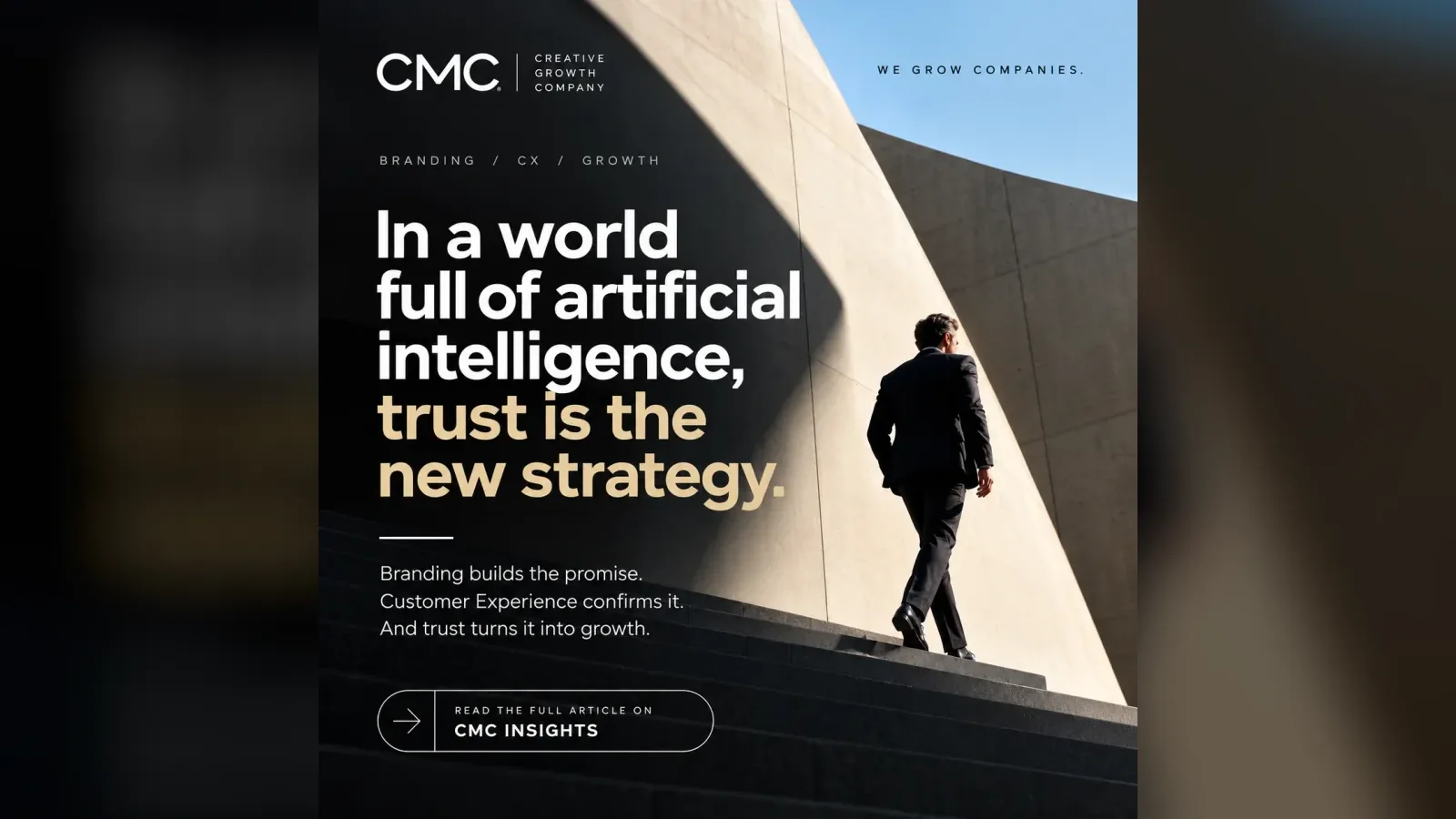
In a world full of artificial intelligence, trust is the new strategy.
How to connect branding, Customer Experience and artificial intelligence to keep the brand promise, earn trust and build stronger customer relationships.
October 17, 2026