Does Driving a Ferrari Make You Schumacher?
Artificial intelligence can multiply what we are capable of. But what happens when we confuse having an extraordinary tool with knowing how to use it?
October 18, 20265 min read
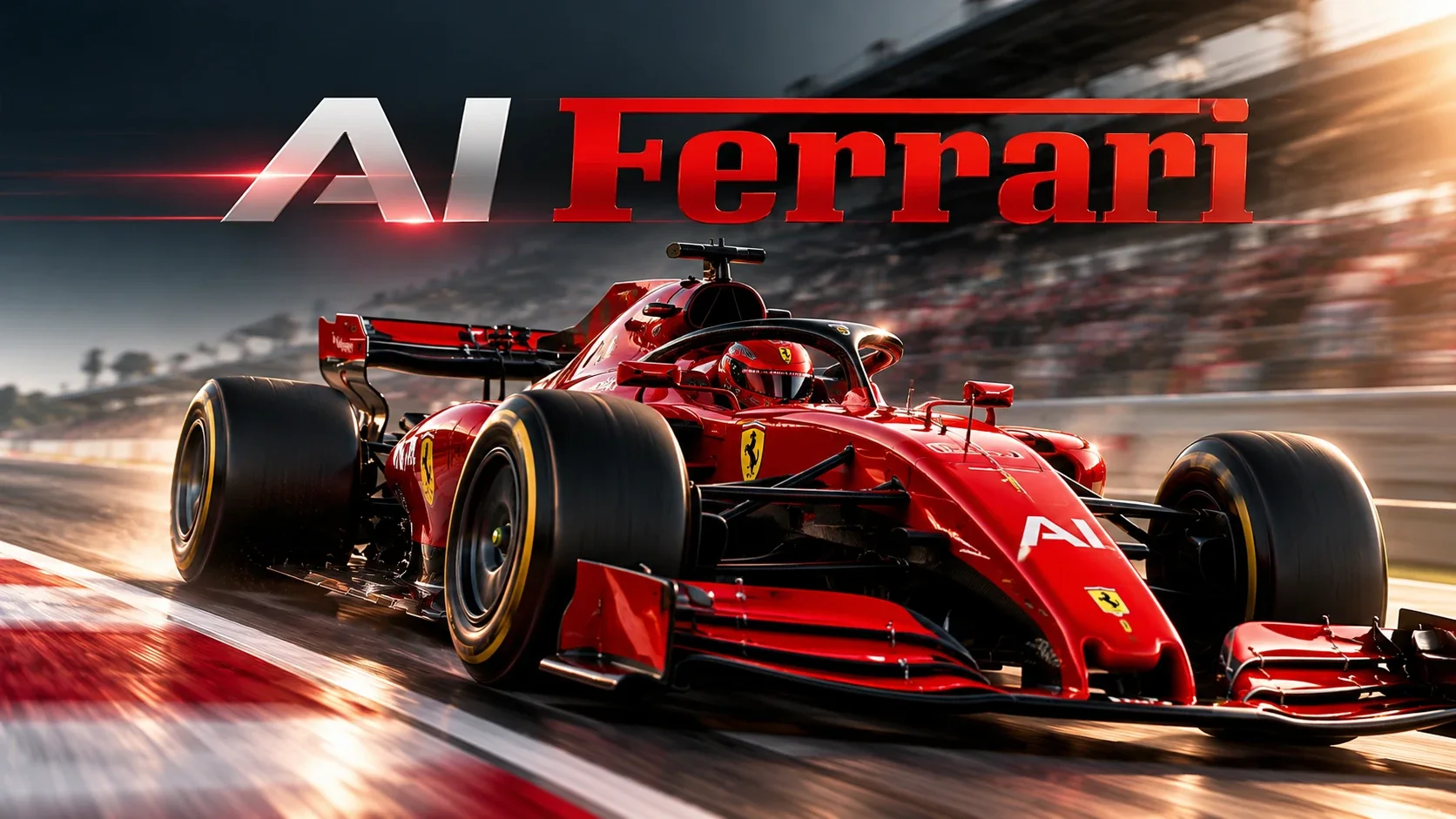
Imagine that tomorrow someone hands you the keys to a Ferrari.
An extraordinary engine. State-of-the-art technology. A machine built to reach speeds most of us will never experience.
Now imagine they put you on the starting grid of a Formula 1 race.
Does owning that Ferrari make you Michael Schumacher?
Of course not.
Because having access to an extraordinary machine is one thing. Knowing what to do with it is something else entirely.
Something similar is happening with artificial intelligence.
The tool was democratised.
Judgment was not.
Today almost anyone can reach artificial intelligence tools able to write copy, produce images, analyse information, generate code and automate processes.
It is an extraordinary technological shift.
But there is something that worries me.
We are starting to confuse the ability to produce with the ability to think.
They are not the same thing.
A tool can generate a hundred ideas in seconds. But who decides which one actually has value?
It can build an entire advertising campaign. But who knows whether that campaign answers the real problem of the business?
It can lay out a seemingly flawless strategy. But who spots it when the premises it was built on are wrong?
Artificial intelligence can speed up an answer. That does not mean the question was the right one.
The real advantage is not going faster.
It is knowing where to go.
For years I worked connecting strategy, creativity, technology and business.
And if I learned one thing along the way, it is that the problem a company believes it has is often not the problem it actually needs to solve.
A company may ask for more advertising when what it really needs is to improve its conversion.
It may invest in winning new customers while quietly losing the ones it already has.
It may bring in sophisticated technology to automate processes that were never designed properly in the first place.
And it may produce enormous amounts of content without building a meaningful relationship with its audience.
Artificial intelligence can help in every one of those scenarios.
But first someone has to understand what is actually going on.
Someone has to ask the uncomfortable questions.
Someone has to connect information, experience, intuition, context and commercial objectives.
Because doing the wrong thing faster does not make it right. It just lets us be wrong at greater speed.
When everyone has a Ferrari.
There is another dimension of this transformation that I find especially interesting.
What happens when everyone has access to extraordinary tools?
Once a technology stops being exclusive, owning it is no longer enough to stand apart.
Competitive advantage starts to move towards other things.
- The quality of the questions.
- The depth of the analysis.
- The creativity to find different paths.
- The experience to anticipate consequences.
- The sensitivity to understand people.
- And, above all, the judgment to decide.
This does not mean experience guarantees better results, or that younger generations are at a disadvantage.
In fact, someone young, curious and with an enormous capacity to learn can use these tools brilliantly.
What matters is not how many years we have been working.
What matters is how much value we are able to create with what we know and with what we are willing to learn.
AI does not automatically replace talent.
But it changes the rules.
It would be naive to claim that artificial intelligence will not replace tasks, transform professions or deeply change the way we work.
It is already changing how a great many things get done.
And it will probably keep doing so.
But I believe the more interesting question is not simply how many jobs a machine will be able to do.
The question is which human capabilities become more valuable in a world where producing information, images, analysis and content gets easier by the day.
My hypothesis is that strategic thinking, critical judgment, creativity with purpose and the ability to understand complex problems may matter even more.
Although we will also have to prove that value.
Because experience on its own is not enough either.
A professional who refuses to learn new tools risks being limited by their own knowledge.
And someone who uses artificial intelligence without developing judgment may end up depending on answers they cannot evaluate.
The challenge is to combine both.
Experience and learning. Technology and thinking. Speed and direction.
The future does not necessarily belong
to whoever holds the best tool.
Let us go back to the Ferrari.
You can have the best engine, the most advanced technology and an extraordinary machine.
You still need to read the circuit, interpret the conditions, make decisions under pressure and know when to accelerate and when to brake.
Something similar happens in business.
Artificial intelligence can become an extraordinary multiplier.
But multiplying a bad decision does not turn it into a good one. And scaling the wrong strategy can only make its consequences larger.
So rather than asking what artificial intelligence can do for us, we should start asking ourselves:
Are we developing the judgment we need to make the most of everything it can do?
Because the goal should never be simply to produce more.
It should be to think better, decide better and create more value.
And perhaps that is one of the great opportunities of this new stage.
Not to compete against the machine. To learn how to drive it.
Now I would like to hear your view.
This article does not try to close the debate.
Quite the opposite.
I want to open a conversation among professionals, business owners, founders and people living this transformation from different perspectives.
Do you think artificial intelligence will make qualified human talent more valuable, or that it will end up replacing a significant part of its work?
You may see this completely differently from the way I do.
And that is precisely why I would like to hear it.
Because the most interesting ideas do not always appear when everyone agrees.
Sometimes they show up when someone dares to question what we think we know.
Your view can be part of this story too.
I invite you to share your perspective on LinkedIn, in the conversation I opened alongside this article. Some of the reflections we receive may be selected, with credit and prior permission, for a future edition of CMC Insights.
And if you would rather write to me privately, the contact page is always open.
Because the future of business is not built on technology alone.
It is also built by talking, questioning and learning from one another.
The conversation continues with you.
Carlos Martín Cortés
Founder & Growth Partner
CMC Creative Growth Company
We Grow Companies.
- Artificial Intelligence
- Strategy
- Leadership
- Critical Thinking
- Growth
Let's Find Your Next
Growth Opportunity.
If something here resonated with a problem you are facing, that is the best place to start a conversation.
Let's TalkArticlesCustomer Experience & Loyalty
Your bank knows what you spend.
But does it know when it's about to lose you?
Banks record thousands of signals about their customers, but recording is not understanding. Where growth is lost while data, CRM, customer experience and AI still operate apart.
October 19, 2026
ArticlesBranding & Strategy
In a world full of artificial intelligence, trust is the new strategy.
How to connect branding, Customer Experience and artificial intelligence to keep the brand promise, earn trust and build stronger customer relationships.
October 17, 2026