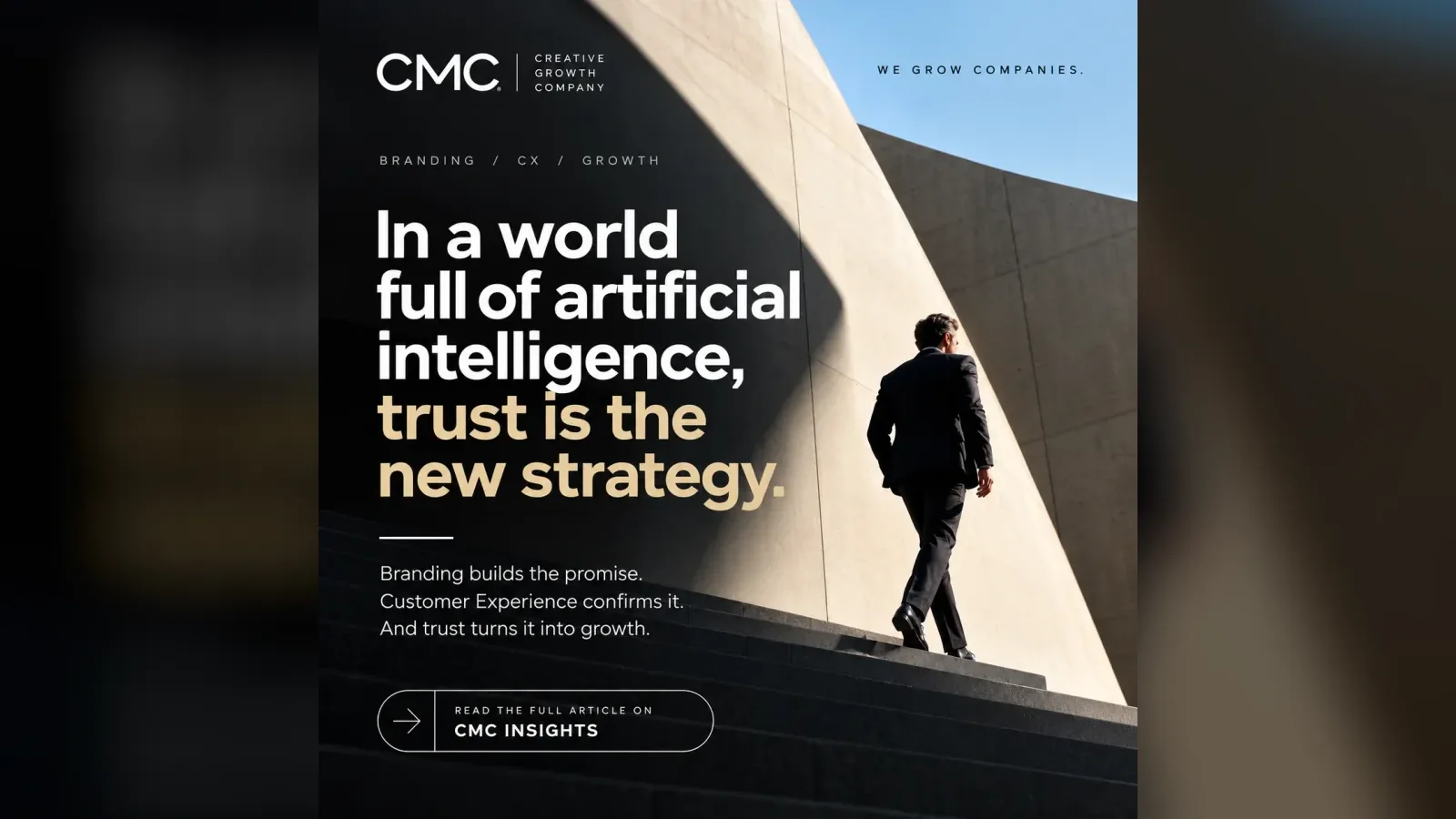
In a world full of artificial intelligence, trust is the new strategy.
The real power of branding is not only in making a promise. It is in keeping it, sustaining it, and turning it into growth.
October 17, 20267 min read
Producing content has never been easier.
Thanks to artificial intelligence, we can now create campaigns, images, videos, messages and digital experiences at a speed that only a few years ago seemed impossible.
And that is extraordinary.
But it also leaves us with a question:
If every company has access to similar tools, where does real differentiation come from?
I believe the answer lies in something that always mattered, but that today takes on an even greater strategic dimension: trust.
And that is precisely where branding comes into its own.
Branding makes the promise.
Customer Experience has to keep it.
For years, many companies poured enormous effort into communicating who they were, what they offered and why consumers should choose them.
But a brand is not built on advertising, visual identity or positioning alone.
A brand is also a promise.
And that promise has to hold up in every single interaction with the customer.
Branding builds expectations. Customer Experience (CX) either confirms them or contradicts them.
We can run the best advertising campaign in the world. But if the customer experience does not live up to what was promised, we are building expectations we then fail to sustain.
And the consequences of that go far beyond reputation.
They are financial.
Some companies have been in business for decades
and still depend on the customers who arrive tomorrow.
Think of a company that has to invest permanently to win new customers.
It invests in advertising, generates traffic, gathers prospects, closes sales.
And the next day it starts over.
And the day after that, again.
It can be twenty or thirty years into its operation and still depend on a sufficient volume of new customers coming in every month.
What would happen if its main source of acquisition stopped for thirty days?
For some companies, the impact would be severe.
Why?
Because they have developed a great capacity to acquire customers, but not necessarily the same capacity to keep them, understand them, earn their loyalty and grow their value over time.
These are companies that learned how to sell, but did not always learn how to build relationships.
And that may be exactly where their biggest growth opportunity lies.
A customer is not the end of a campaign.
It is the beginning of a relationship.
A sale should not be the end of the marketing work.
It should be the beginning of a new stage.
A stage in which the company already holds something extraordinarily valuable: a person who decided to trust it.
It knows their name, their history, their preferences and, depending on the business, their needs and their previous experiences.
And yet many organisations still direct their greatest effort at people who do not know the brand, while overlooking the chance to create value with the ones who already chose it.
This is where a fundamental concept comes in: Customer Lifetime Value (CLV or LTV).
The value of a customer should not be measured by their first purchase alone.
What also counts is how long they stay, how often they come back, which additional products or services they need, what it costs to serve them, and what margin they generate across their entire relationship with the company.
This is not simply about selling them more.
It is about understanding them better in order to offer them more value.
And when we do that properly, opportunities appear: repeat purchase, upselling, cross-selling, loyalty and advocacy.
Real growth is not only about winning more customers. It is about building relationships that create more value over time.
Today, the customer is the new influencer.
They do not need a million followers.
They do not need to be a celebrity.
A customer who lives an extraordinary experience can become one of the most credible voices a brand has.
They can recommend it, choose it again and share what happened to them.
But they can also do exactly the opposite when they feel the promise was not kept.
That is why Customer Experience should not be treated as an operational or customer-service responsibility alone.
It is a core part of brand and growth strategy.
The best advertising can win a first sale. A great experience can help win many more.
And there is an important difference: advertising is what a company says about itself. A recommendation is what someone else decides to say about it.
The trust that recommendation carries is an asset we should not underestimate.
From acquisition marketing
to relationship marketing.
I am not saying companies should stop investing in advertising.
Acquisition will remain necessary to grow, to enter new markets and to reach new audiences.
What I am questioning is a model in which a company depends almost entirely on winning new customers to sustain its business.
Because when an organisation improves its experience, strengthens the relationship with its customers and grows their value over time, it can build a more solid revenue base.
And that makes it possible to revisit how it allocates its investment.
Perhaps it does not need to spend every new dollar looking for customers outside.
Perhaps part of that investment would deliver better results working intelligently with the customers it already has.
- With CRM.
- With personalisation.
- With loyalty programmes.
- With automation.
- With relevant experiences.
- With retention, reactivation, upselling and cross-selling strategies.
- And with artificial intelligence applied to understanding needs, spotting opportunities and reaching the customer at the right moment.
A customer base should not be just a list of contacts. It should be one of the most strategic assets a company owns.
Naturally, all of this requires working with data responsibly, respecting the privacy and the preferences of every person.
Technology does not replace judgment.
It multiplies it.
This is where artificial intelligence comes back in.
We can automate messages, analyse behaviour, identify patterns and personalise experiences at scale.
But no tool can decide on its own what promise a brand should make, what experience its customer needs, or what relationship it wants to build with them.
For that we need professionals able to connect disciplines that worked apart for far too long.
Branding, strategy, creativity, CX, CRM, loyalty, technology and business.
Professionals who do not stop at running campaigns, but who understand how the business works and where its growth opportunities are.
Because automating a bad experience does not turn it into a good one.
It just lets you repeat it faster.
The new marketing should
work for us.
For years, many companies built structures that need to produce campaigns constantly in order to feed their growth.
More content.
More ads.
More leads.
More spend.
And back to the beginning.
But let us imagine a different model.
- A company that keeps its brand promise.
- That knows its customers.
- That offers relevant experiences.
- That gets them to come back because they want to come back.
- That spots commercial opportunities without bombarding them with promotions.
- That turns satisfied customers into advocates.
- That uses artificial intelligence to strengthen those relationships.
- And that gets a growing share of its business from the value it has already built.
That is the marketing I am interested in.
A marketing that does not settle for generating activity, but builds assets, relationships and sustainable opportunities.
A marketing where technology works in the service of strategy and of people.
A marketing that works for the company, instead of a company that spends its life working to feed its marketing.
The question we should be asking.
What is the point of investing millions in building a brand if we are then unable to keep and sustain its promise?
And I would add another:
Are we building a company that grows through the relationships it creates, or a company that needs to buy new customers every day in order to keep going?
Perhaps the next great growth opportunity is not only in the customers we do not have yet.
Perhaps it is in all the value we have not yet learned to build with the customers who already trusted us.
Carlos Martín Cortés
Founder & Growth Partner
CMC Creative Growth Company
We Grow Companies.
- Branding
- Customer Experience
- Brand Trust
- Artificial Intelligence
- Growth Strategy
Let's Find Your Next
Growth Opportunity.
If something here resonated with a problem you are facing, that is the best place to start a conversation.
Let's TalkArticlesCustomer Experience & Loyalty
Your bank knows what you spend.
But does it know when it's about to lose you?
Banks record thousands of signals about their customers, but recording is not understanding. Where growth is lost while data, CRM, customer experience and AI still operate apart.
October 19, 2026
ArticlesAI & Technology
Does Driving a Ferrari Make You Schumacher?
Artificial intelligence democratised the tool, not the judgment. Why the real advantage is no longer producing faster, but knowing which questions to ask and where to go.
October 18, 2026